Published at Jul 24, 2026 , Updated at Aug 10, 2026
 Jakub Mrocek
 Bears in Slovakia: How Many There Are, Where They Live, and a Map of Attacks
The debate over bears in Slovakia is louder than at any point in living memory. Headlines, districts under a state of emergency, political statements about overpopulation, a nationwide cull. Somewhere in all of that, a simple question gets lost: what do the data actually say about bears in Slovakia, and what is simply part of the argument?
We spend most of our time in the Slovak mountains, using trail cameras and filming wildlife. Bears regularly appear in our footage, so what interests us is what they actually do and where they move, not who is winning the political argument. This article pulls together the best available numbers and explains them soberly: how many bears live in Slovakia, where you are most likely to meet one, whether they really are overpopulated, how big the risk of an attack is, and what to do if you run into one. If you plan to hike, take photographs, or ski in the Tatras, the Fatras, or anywhere in the central and northern ranges, this is bear country, and the article covers exactly those areas.
Bears by district: reports, attacks and deaths
The question people ask first is simple: is the area I am heading into quiet, or is it a problem area? The map below answers that from official data. The color of each district (okres, the Slovak administrative unit) matches the number of bear sighting reports in 2026 recorded by Štátna ochrana prírody SR (the State Nature Conservancy of the Slovak Republic, ŠOP SR from here on), and a hatched border marks the districts placed under a state of emergency in April 2025. The toggle in the top right switches between reports and documented attacks from 2021 to 2026, so you can see not only where bears are being reported but also where incidents have actually happened.
The same data are available as a table, sorted by the number of reports. The “attacks 2021-2026” column gives the number of documented incidents in the district (per ŠOP SR and media reports; the list is incomplete), the “deaths” column counts the people who have died in an encounter with a bear since 2021, and “state of emergency” marks the districts covered by the government decision of April 2025. Three of those four deaths were direct fatal maulings (Liptovská Lúžna 2021, Hybe 2024, Detva 2025). The fourth was a woman who died in March 2024 in the Low Tatras (Liptovský Mikuláš district) after falling into a ravine while fleeing from a bear. There was no physical contact, but the bear’s behaviour caused her death, so we count it both as a death and as an attack.
Show the table of reports by district (as of 10 August 2026)
| District | Reports 2026 | Attacks 2021-2026 | Deaths (2021-2026) | State of emergency |
|---|---|---|---|---|
| Liptovský Mikuláš | 402 | 15 | 2 | yes |
| Banská Bystrica | 219 | 3 | yes | |
| Prievidza | 157 | 8 | yes | |
| Poprad | 96 | yes | ||
| Martin | 93 | 9 | yes | |
| Detva | 61 | 3 | 1 | yes |
| Zvolen | 54 | 3 | yes | |
| Žilina | 48 | 5 | yes | |
| Žiar nad Hronom | 43 | 3 | yes | |
| Ružomberok | 41 | 3 | 1 | yes |
| Turčianske Teplice | 39 | 1 | yes | |
| Košice - okolie | 34 | yes | ||
| Brezno | 31 | yes | ||
| Revúca | 27 | yes | ||
| Gelnica | 26 | yes | ||
| Prešov | 25 | yes | ||
| Medzilaborce | 20 | yes | ||
| Spišská Nová Ves | 20 | yes | ||
| Trenčín | 18 | yes | ||
| Snina | 13 | yes | ||
| Dolný Kubín | 12 | yes | ||
| Kežmarok | 8 | yes | ||
| Poltár | 8 | 1 | yes | |
| Rožňava | 8 | yes | ||
| Sobrance | 8 | |||
| Vranov nad Topľou | 8 | yes | ||
| Bardejov | 6 | yes | ||
| Ilava | 6 | yes | ||
| Stará Ľubovňa | 6 | yes | ||
| Svidník | 6 | yes | ||
| Kysucké Nové Mesto | 5 | 1 | yes | |
| Rimavská Sobota | 5 | yes | ||
| Stropkov | 5 | yes | ||
| Topoľčany | 5 | yes | ||
| Tvrdošín | 5 | 1 | yes | |
| Žarnovica | 5 | yes | ||
| Krupina | 4 | yes | ||
| Považská Bystrica | 4 | yes | ||
| Púchov | 4 | yes | ||
| Bánovce nad Bebravou | 3 | yes | ||
| Bytča | 3 | yes | ||
| Čadca | 3 | yes | ||
| Banská Štiavnica | 2 | yes | ||
| Humenné | 2 | yes | ||
| Levice | 2 | yes | ||
| Levoča | 2 | yes | ||
| Lučenec | 2 | 1 | yes | |
| Námestovo | 2 | 1 | yes | |
| Nitra | 2 | |||
| Nové Mesto nad Váhom | 2 | |||
| Partizánske | 2 | yes | ||
| Sabinov | 2 | yes | ||
| Piešťany | 1 | |||
| Skalica | 1 | |||
| Veľký Krtíš | 1 | yes | ||
| Zlaté Moravce | 1 | yes |
When bears are most active and when attacks happen
Bears in Slovakia are active roughly from April through November; most spend the winter asleep in dens. Reported sightings therefore peak in summer. Attacks follow a different pattern, and that difference is the most interesting feature of the chart below:
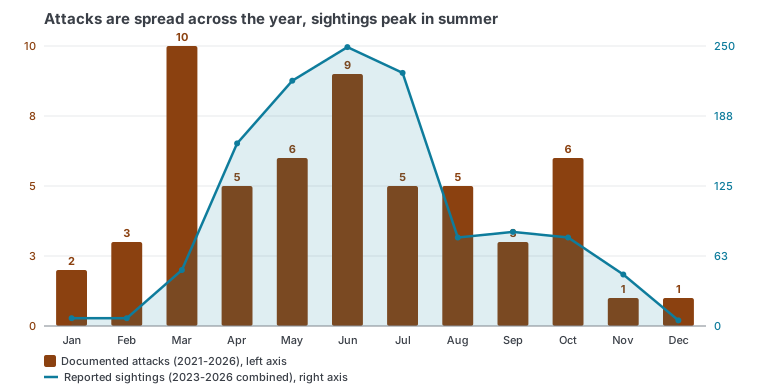
The two patterns do not line up, and that is the key point. We collected all 58 documented bear attacks in Slovakia from 2021 through August 2026. The data show the following:
- Attacks have two peaks: March and June. There were ten in March and nine in June. Reported sightings peak later, between May and July.
- August and October also stand out, with seven and six cases. In three of the October cases, the person attacked was picking mushrooms.
- We have at least one documented attack in every month of the year. A quieter season does not mean zero risk; it only means fewer encounters.
- Attacks happen during daylight. Of the 55 cases for which the time is known, 54 happened in daylight, most often in the morning.
- The bear is usually female. Among cases where the animal’s sex is known, 34 of 40 involved a female.
- These attacks are defensive, not predatory. No documented case in Slovakia was predatory, meaning one in which the bear hunted a person as prey.
The number of bears and people in the forest does not explain these peaks. What both groups are doing in a given month does. In spring, people venture deep into the forest, away from roads, while female bears are still near their dens. Bear mating season peaks in May and June, and mushroom pickers head into the forest in autumn. How such an attack unfolds and what to do while it is happening is covered in a separate article on how to survive a bear attack.
The sightings curve is crowd-sourced and intended only as a guide; ŠOP SR does not publish official monthly counts.
We documented every one of these attacks case by case in a separate article on bear attacks in Slovakia: it lists every documented case in a table with sources and analyses when attacks happen, who is attacked and why.
The map needs to be interpreted carefully. A report is neither an attack nor a measure of danger. It is a public submission saying someone saw a bear or found its tracks, so the numbers also reflect how many people move through a district and how diligently they report. A high report count means you should expect bears in the area, not that one is waiting around every corner.
To get a day-to-day sense of bear activity, live report maps are the tool to use. The official one is run by ŠOP SR at pozormedved.sk, which is also where the data in our map above comes from. Other public maps compile almost every reported bear sighting. For any map of this kind, the same caveats apply:
- A point means a sighting or a warning reported at that time. It is not GPS tracking of a bear and not confirmation that the bear is still there.
- Most reports are ordinary sightings or a bear at a trash bin, not an attack. The two are not the same thing.
- The absence of a point in your valley over the past week does not mean there is no bear there. And a single point does not make a whole region dangerous.
So the map is useful for orientation and for knowing where to pay closer attention. It is not a crystal ball, and it is certainly no reason to panic.
How many bears live in Slovakia?
The best available scientific estimate is roughly 1,056 bears, with a 95 percent confidence interval of 1,012 to 1,275 animals. That figure comes from a genetic study by ŠOP SR and Charles University in Prague, which processed more than 2,000 samples of bear hair and scat collected between 2019 and 2021. The results were published in 2023 and summarized by the science portal Veda na dosah.
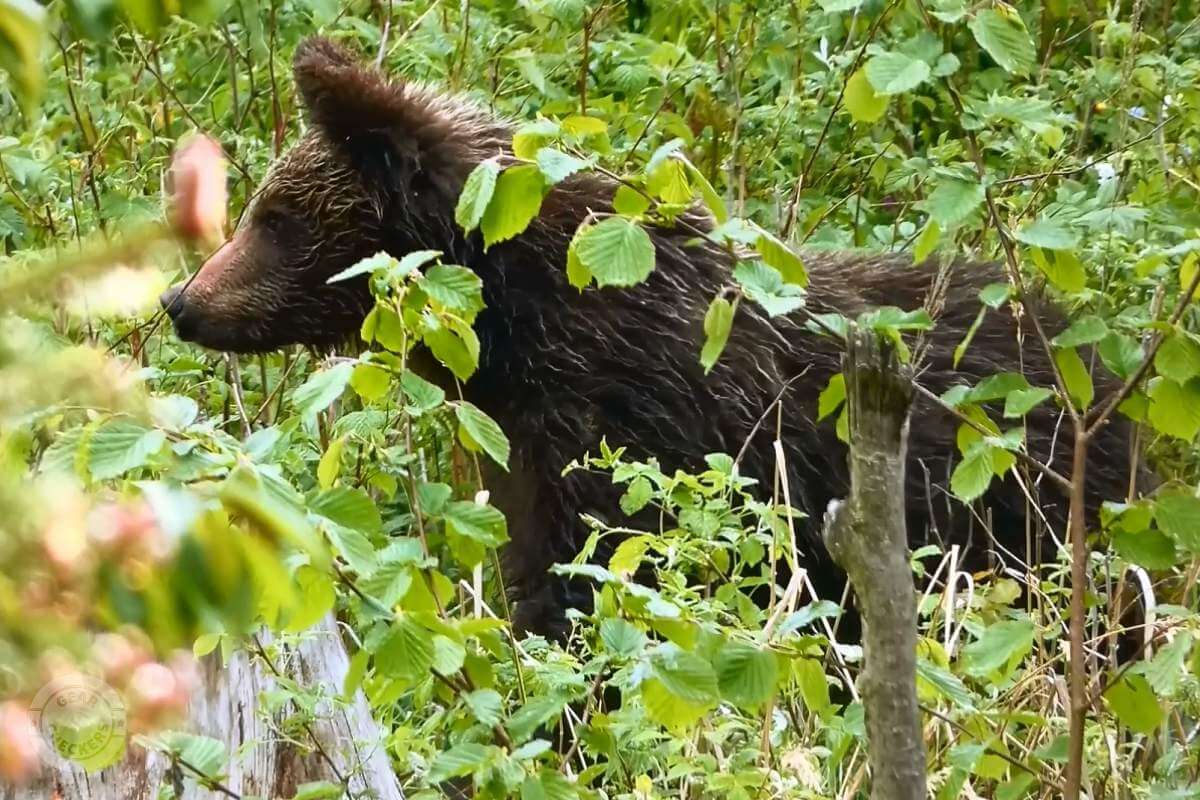
This was not the first such estimate. An earlier genetic study from 2014 put the population at 1,256 animals. The difference between the two studies falls within the margin of statistical error, so the studies do not show either a sharp increase or a decline. Tracking the trend was not a direct goal of the newer study either. The honest formulation is therefore this: Slovakia has on the order of a thousand bears, and the data do not confirm that their numbers have grown dramatically in recent years.
So why do you hear figures like 2,000, 2,600 and more? Because different counting methods get mixed together. Traditional estimates are built on sightings, tracks in the snow and damage reports. Their weakness is that they can count the same bear several times over. A bear has a large home range and covers several cadastral areas in a few days. When people in three different valleys independently record its tracks or see the animal itself, one bear easily becomes three in the totals. That is exactly how the counts get inflated.
The genetic method solves this. Every sample of scat or hair yields a unique DNA profile, effectively a fingerprint of one individual animal. The same bear is counted only once, even if we find samples from it in five places. That is why a genetic census produces a lower estimate than a tally of sightings, and why it is considered more accurate. The higher figures from hunting and forestry circles mostly rest on those traditional methods. Next time you see a “precise” number, it is worth asking which method produced it and what year it comes from.
On top of that, a new nationwide genetic monitoring program started in 2025. Its results will come later, so the 2023 study remains the reference point for now.
Where bears live in Slovakia
Picture the mountainous belt running from Malá Fatra through the Low Tatras down to Poľana, and you are looking at bear country. In Slovakia, bears mainly occupy the mountain and foothill areas in the central and northern parts of the country, and by 2022 their range had expanded to roughly 16,300 km². In the lowlands of the south and southwest, you will almost never encounter one; there is not enough forest or seclusion for bears there.
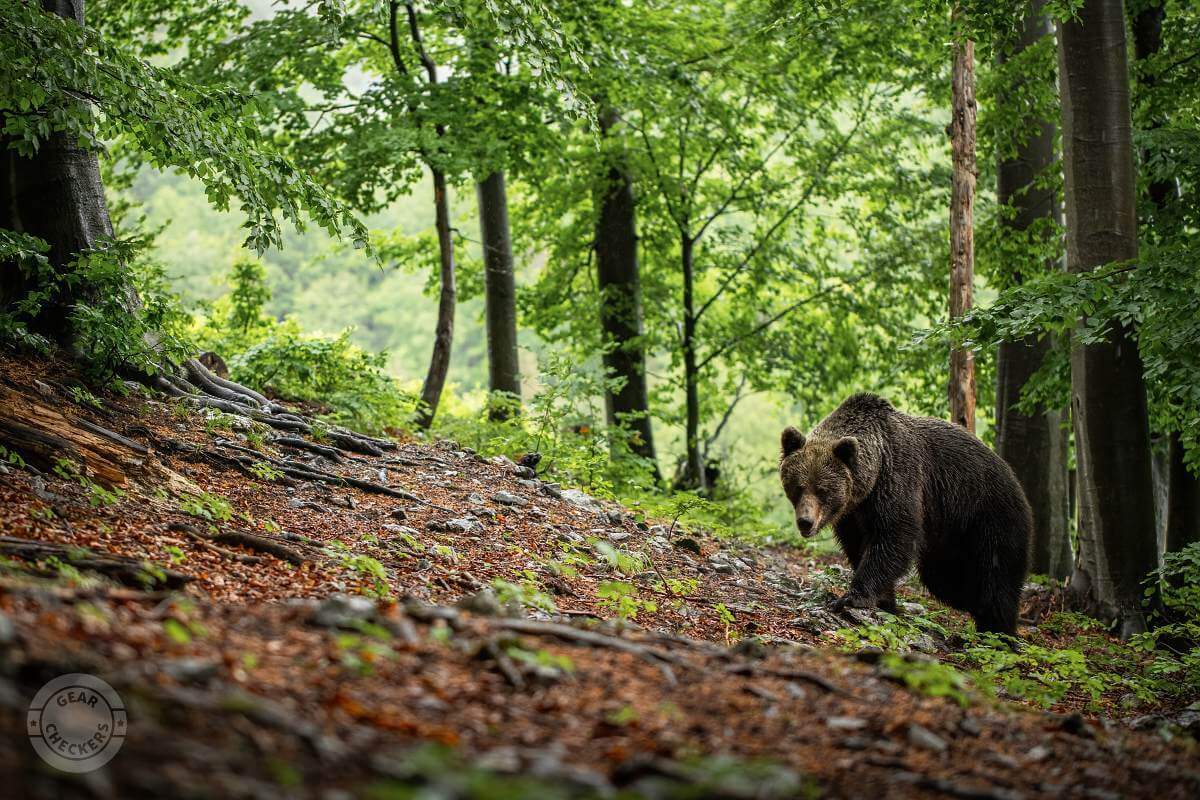
Density is far from uniform. The largest subpopulation lives in the Poľana Protected Landscape Area, where the study estimates around 278 bears, which works out at roughly 13 animals per 100 km². Next comes the High Tatras area with 152 animals, followed by Veľká Fatra with 146, Malá Fatra with 123, the Low Tatras with about 97, and Muránska planina with 71. There are higher concentrations in the Kremnické vrchy range as well.
For a clearer overview, here are the largest subpopulations according to the genetic study:
| Mountain range / area | Estimated number of bears |
|---|---|
| Poľana (Protected Landscape Area) | ~278 |
| High Tatras (area) | ~152 |
| Veľká Fatra | ~146 |
| Malá Fatra | ~123 |
| Low Tatras | ~97 |
| Muránska planina | ~71 |
For visitors, this means one thing: your chance of meeting a bear is highest in exactly these ranges, especially where bears have access to food from people as well as natural food sources.
The season matters too. Bears in Slovakia are active roughly from spring to late autumn, and they cover the most ground looking for food in autumn, during what is called hyperphagia. Hyperphagia is the period before hibernation when a bear eats everything it can get and takes in several times more food per day than at other times, building up fat reserves for the whole winter. That is when it most often comes close to orchards, maize fields and the edges of villages. In winter most bears sleep in a den, although in mild winters with food available they may not sleep continuously.
Are bears in Slovakia overpopulated? What science says and what politics says
This is the core of the whole dispute, and the answer is more cautious than the headlines suggest.
The genetic study estimated the number of bears, but it did not test the carrying capacity of the environment, meaning how many bears a given territory can support. Without that, “overpopulation” cannot be scientifically confirmed or refuted. Verifying it would require ecological modeling of carrying capacity and food supply, which is not available yet. The data show only that there are on the order of a thousand bears and that their numbers are not growing dramatically.
What is demonstrably changing is the number of conflicts. Reports of bears near settlements rose from roughly 620 in 2021 to about 1,950 in 2024, according to the Slovak Ministry of the Environment. That is a real administrative figure. On its own, though, it does not prove that there are more bears. The increase can also reflect changes in their behavior, the availability of food from people, more people out in the field, and more consistent reporting.
There is a concrete mechanism behind that behavior. Unsecured bins, illegal baiting sites, maize in the foothills and development spreading into open country all pull bears closer to people. A study of bear feeding ecology from Poľana and the Veporské vrchy found that roughly 20 percent of the bears’ dietary energy came from human-linked sources such as cereals, maize and fruit. A bear that gets used to easy food near a village loses its shyness and stays close to people. An animal like that is described as synanthropic, and it is the type that causes problems most often.

That leaves three positions in the dispute. The scientific estimate is around a thousand animals, and the study did not directly test overpopulation. The government declared bears overpopulated and used that to justify both the state of emergency and the cull. Hunting and forestry circles use higher estimates and are calling for regulation.
One thing is almost always left out of the debate about a “surplus” of bears. For a species to survive in the long term, a headcount alone is not enough. It needs a population that is large enough and well connected. Below a certain threshold, inbreeding starts to show, resistance to disease drops, and the population slowly collapses even though on paper some bears are still there. That is why geneticists focus not on the raw count but on the effective population size, meaning the number of individuals that actually reproduce and pass their genes on. In Slovakia, the study puts it at only about 266. The Western Carpathian population is also fragmented and partly isolated, because the D1 motorway, the E50 road and the Váh valley block gene flow. A count of a thousand bears is not the same thing as a thousand bears in a safe, healthy population.
In spring 2025 the government declared a state of emergency in 55 districts and approved an extraordinary cull of up to 350 bears, with the aim of pushing the population below a thousand animals. Large-carnivore specialists called the figure of 350 arbitrary, literally “pulled out of thin air”. Briefly, the legal framework is as follows: the brown bear is a strictly protected species under the European Habitats Directive, but Article 16 of that directive allows exemptions, for example on public safety grounds, provided there is no other satisfactory solution and the conservation status of the species does not deteriorate. So the cull is not plainly illegal, but neither does the government have a free hand.
Culling did not begin in the past few months. According to the available figures, at least 383 bears died in Slovakia over the past two years; around 144 were killed in 2024 alone, and considerably more in 2025. Despite that, the number of attacks on people has not fallen. The opposite is true: according to ŠOP SR there were eleven in 2024 and seventeen in 2025. This is the crux of the whole argument. If the problem were caused by bear numbers alone, years of record culling would have pushed conflicts down. They did not.
From where we stand, the data therefore support one conclusion more strongly than the others. The current problems are driven above all by bear behavior and the availability of human food, not by a proven population explosion. Oddly enough, that is good news because, unlike a raw headcount, those causes are things we can influence directly.
Are bears dangerous? The risk of an attack in numbers
A bear attack on a person is rare in Slovakia and usually defensive. Long-term records from zoologist Robin Rigg, who has studied Slovakia’s bears for decades, and the Slovak Wildlife Society show that roughly 124 incidents occurred between 1998 and 2025. They injured 142 people, and four of the incidents were fatal. Over the long run, that works out to roughly four to five attacks a year. We have maintained our own database since 2021, and it contains 58 documented attacks in which four people died. None of those attacks was predatory, meaning one in which the bear hunted the person.
Recent years, however, are well above that average. ŠOP SR recorded eleven attacks in 2024 and seventeen in 2025. In 2021, the state forestry company Lesy SR confirmed the first documented modern case of a bear killing a person. The victim was a man near Liptovská Lúžna. Two more deaths followed in 2024: a mushroom picker near Hybe, and a woman who died in the Low Tatras after falling into a ravine while fleeing from a bear. The most recent fatal attack happened on 30 March 2025, when a bear killed a 59-year-old man above Detva. That tragedy is what triggered the state of emergency and the decision on the cull plan. For 2021 to 2025, then, the records show three direct fatal attacks and one related death, and no death on Slovak territory in 2026.
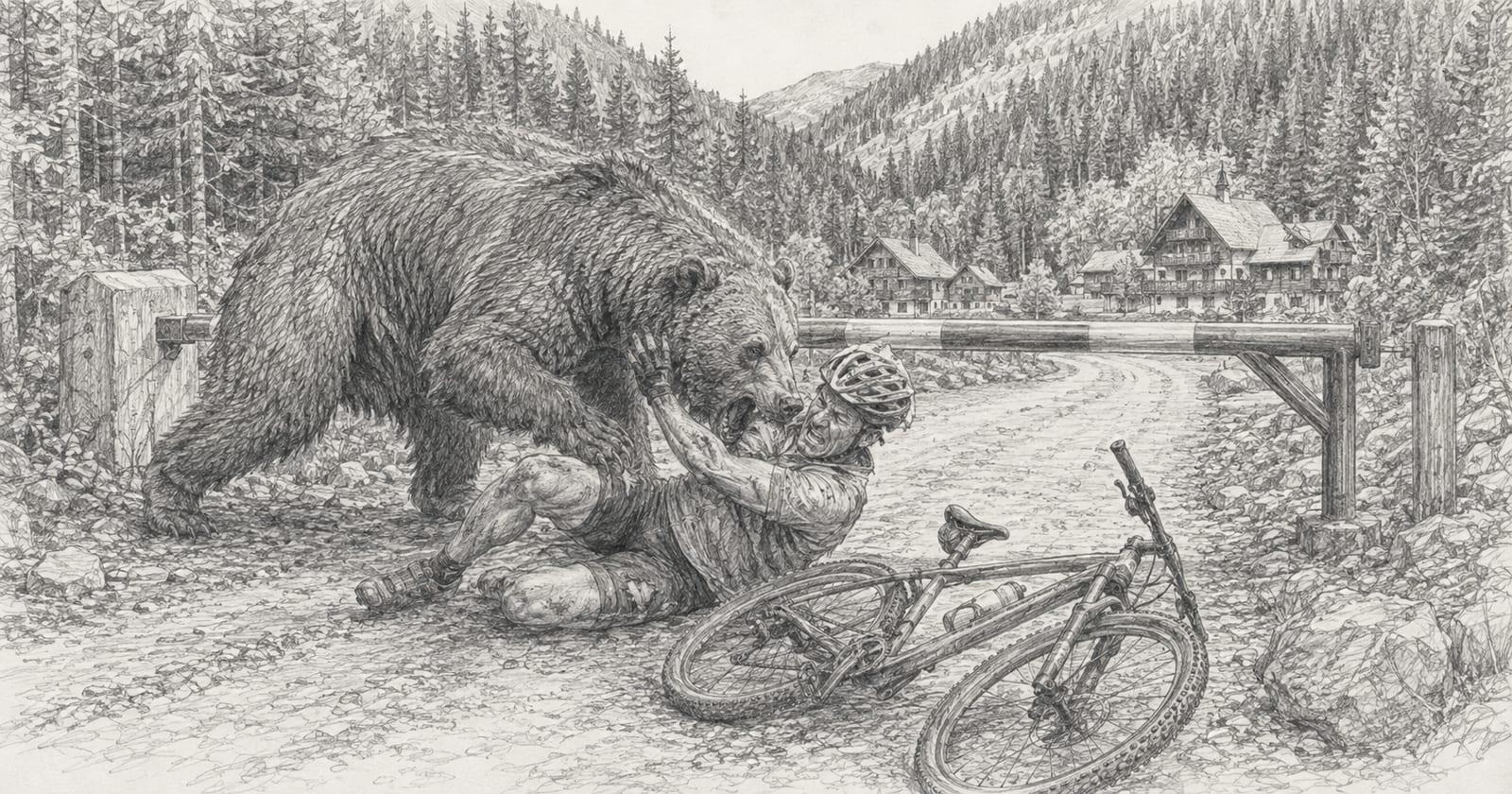
Understanding the nature of these attacks matters, because it dictates how you defend yourself. The documented Slovak attacks are defensive, not predatory. A bear does not regard a human as prey. It reacts defensively when someone surprises it at close range, when a person comes across a female with cubs, when a loose dog comes into contact with it, or when the wind carries a person’s scent to the bear only at the last moment. That is a fundamental difference from the image of a predator lying in wait for a hiker.
A video by our co-founder Lukáš shows what such a defensive attack actually looks like. A female bear charged him from fifteen meters, and he came through it thanks to his bear spray.
So the risk needs to be seen in proportion. In absolute terms it is low; we are talking about low double-digit numbers of cases a year against millions of visits to the Slovak mountains. At the same time it is real, and it rises locally in exactly those places where bears are losing their shyness near villages. Low risk is not the same as no risk, which is precisely why it pays to know how to behave.
What to do if you meet a bear, and how to lower the risk
Most problems can be avoided because nearly all of them come down to a surprise at close range. A few simple rules cut the risk considerably:
- On trails with blind sections and in windy conditions, make noise so the bear knows about you in time. You do not want to surprise it.
- Keep your dog on a leash. A loose dog will provoke a bear and bring it back to you.
- Do not leave food or trash behind, and do not approach food remains. A habituated bear is a dangerous bear.
- Avoid dense cover at dusk and dawn, when bears are most active.
- Never feed a bear and never approach it to take a photograph.
If you do run into a bear, the key is not to panic and not to run. Back away slowly, give the animal room to retreat, and do not make sudden movements.
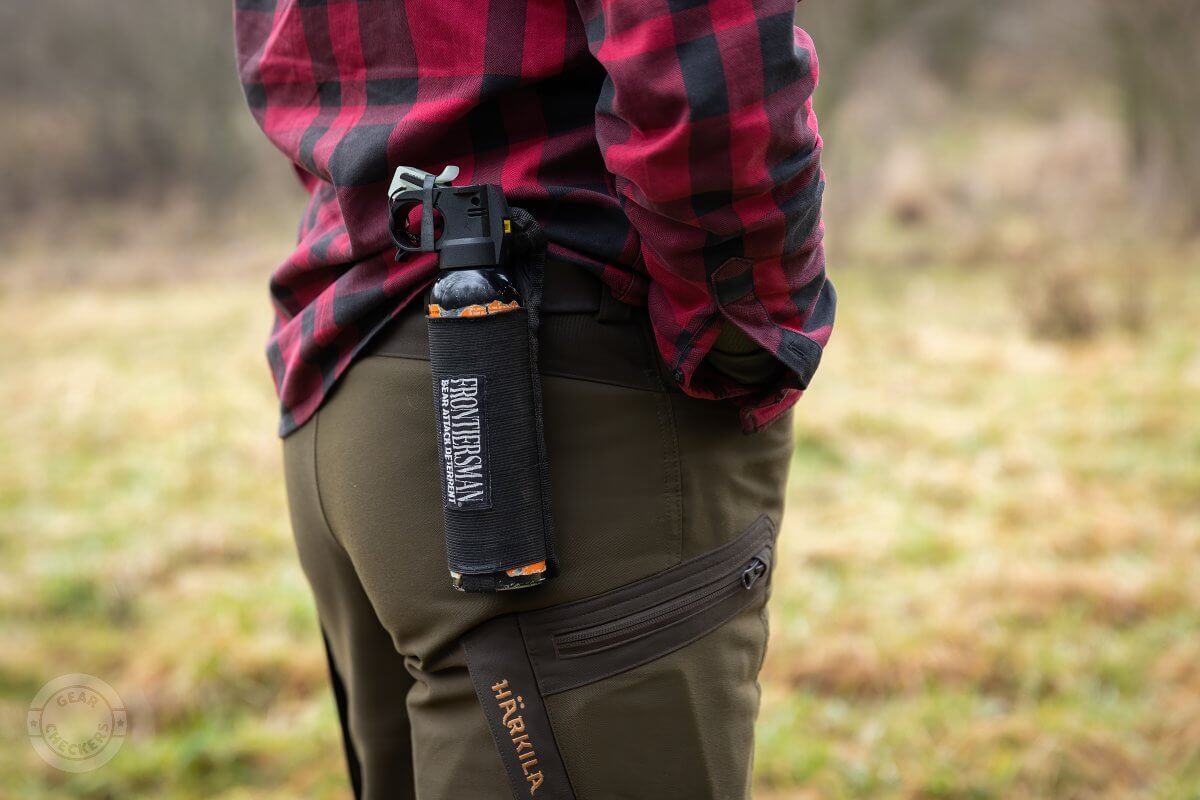
As for active protection, the most effective non-lethal option is defensive bear spray. We carry it in bear country ourselves, and it has proved itself in practice. It is not a guarantee, and you need to know how and when to use it. Of the available options, it has the best record. We tested in detail which sprays actually work and why in our article on the best bear spray.
Frequently asked questions
The best scientific estimate is roughly 1,056 bears (interval 1,012 to 1,275) according to a 2023 genetic study by ŠOP SR and Charles University. The higher numbers that circulate in the public debate come from other, less precise methods.
In the mountain areas of central and northern Slovakia. Poľana holds the densest population, followed by Veľká Fatra, Malá Fatra, the High Tatras area, the Low Tatras and the Kremnické vrchy. For current sightings, use the live report maps.
Yes. You will find the district-level overview in this article, with data from ŠOP SR (pozormedved.sk). To get a day-to-day sense of bear activity, there are live report maps; the official one is run by ŠOP SR, and other public maps exist too. All of them show reported sightings rather than the GPS position of bears, so they are for orientation, not a precise or complete picture.
It is neither proven nor refuted scientifically, because the latest study counted animals, not the carrying capacity of the environment. The population is on the order of a thousand animals and is not growing dramatically. The rise in conflicts is driven mainly by changed behavior and the availability of food from people. The government has declared bears overpopulated and approved a cull in 2025, and specialists criticized that figure.
According to Robin Rigg’s long-term records there were four fatal cases between 1998 and 2025. The first officially confirmed case of a bear killing a person was documented by Lesy SR in 2021, and another confirmed case happened near Detva in March 2025. Set against the number of visits to the mountains, this is a very rare event.
Do not panic, do not run and do not make sudden movements. Give the bear room to retreat and move away slowly. Do not get closer for a photograph, and keep your dog on a leash.
Roughly from spring to late autumn. They cover the most ground in autumn during hyperphagia, when they build up fat reserves before winter, and that is when they most often show up near orchards, fields and the edges of villages. Within the day they are most active at dusk and dawn.
Yes, defensive spray is among the most effective non-lethal ways to stop an attack, provided you have it within reach and know how to use it. We tested which sprays work in our article on the best bear spray.