Published at Jul 26, 2026 , Updated at Aug 11, 2026
 Jakub Mrocek
 Bear Attacks in Slovakia: What We Know and How to Avoid Them
For us, the most interesting part of all our fieldwork on the documentary Think Like a Lynx and our other projects is understanding an animal: why it behaves the way it does. With bears this is no academic question. It has serious practical consequences. Our colleague Lukáš faced a charging female bear himself and got through it thanks to bear spray. Nobody was hurt that day, but it does not always end that way.
To avoid attacks, and to react well if one happens, we wanted to understand them as thoroughly as possible. So we collected every documented bear attack in Slovakia from 2021 to August 2026, 58 cases in total. We count a case as an attack if physical contact occurred, if a point-blank shot was the only thing that stopped the bear, or if a person died because of the bear’s behavior. The severity of the person’s injuries does not affect whether the case counts. We explain the definition in detail in the data section below. For each case we dug up what we could: the time of day, what the person was doing, the terrain, what was known about the bear, and how it ended for both sides. We wanted to know whether any patterns repeated across the cases and whether they could teach us how to avoid such an encounter.
We are filmmakers and outdoor enthusiasts who move through bear country with cameras and regularly service trail cameras, so what interests us is the practical side. We are not here to argue how many bears Slovakia should have. We covered how many bears live here and where in a separate article about bears in Slovakia.
What we learned, in short
The attacker is usually a female. Where the animal’s sex is known, it was a female in 34 out of 40 cases. Cubs are confirmed in twenty-four cases.
It is defense, not hunting. Defense of cubs and surprise at very close range explain most of the cases we could gather enough information about. There is not a single predatory attack among them, meaning one where a bear went after a person with the intent to eat them.
The typical victim is a middle-aged man rather than a hiker with a backpack. He is most often between 35 and 57, alone, and doing something quiet away from the trail. That does not mean every attack looks like this, of course.
Winter and early spring belong to the dens. In three cases it is documented that the attack happened in the immediate vicinity of a den. This does not concern the ordinary hiker on a marked trail. It concerns people who move far off the trails: foresters, hunters, shed antler collectors.
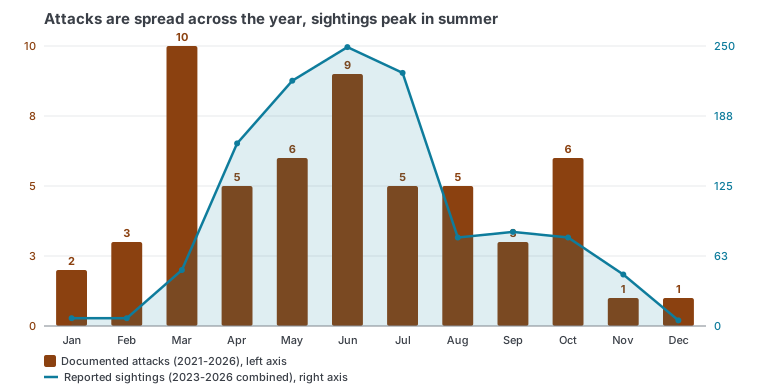
March has the most attacks, and shed antler hunting may play a role. We have ten cases from March, even though for tourism it is one of the weakest months of the year. But this is exactly when red deer drop their antlers, which many people go looking for by systematically combing through every corner of the forest. At the same time, bears are waking up and females with newborn cubs are still at their dens, which raises the risk of an attack considerably.
June is the second peak, and it fits the mating season. Nine cases. The bear mating season peaks in May and June, males cover the most ground per day in that period, and females leading cubs actively avoid them, often in unfamiliar terrain and with cubs they will defend aggressively if surprised.
October belongs to mushroom pickers. In three of the six October cases the victim was picking mushrooms, and half of all mushroom-picking cases in the record fall in this one month. The sample is small, so this is not the only possible explanation, but it is the only month in which mushroom picking is the most common activity of the people attacked.
Runners are quiet in exactly the wrong way. We have eight runners in the record, and the first serious case dates back to 2022. A runner can be heard, but footsteps and breathing sound like any other animal; what warns a bear off is the human voice. On top of that, runners move through the forest two to three times faster than a walker, so the animal has no time to give way, and it can easily read a fast approach as a threat.
Attacks in villages and on their edges are a new and separate problem. Of the ten such cases in the record, nine are from the last three years. They have a different cause and a different solution than attacks in the forest, and they tend to involve lighter injuries.
Attacks happen in daylight. Of the 55 cases where we know the time, 54 happened during the day, most of them in the morning. The only night attack was by a bear that had learned to feed directly in a village.
Bears die after these incidents too. At least ten were killed as a direct result. To that you have to add the broad-scale response that came after the state of emergency was declared in April 2025: according to the State Nature Conservancy (ŠOP SR), 201 bears were killed between April and October 2025. Preventing attacks therefore protects both sides.
Are bear attacks increasing?
This is the question people ask us most often, and it is also the one place where our own table is not enough. For the older cases from 2021 and 2022 we could not find enough information to verify the details. If we turned our numbers into a trend chart, it would mostly show how news coverage improved over time.
So we put both views into one chart. The bars are cases we could document well enough; 2021 and 2022 are the least well-documented years and should not be treated as comparable. The dots are the official annual counts from ŠOP SR, which only count attacks with injury. Where the numbers diverge, the difference most likely comes down to a different methodology, or to the authority also drawing on reports that were never made public.
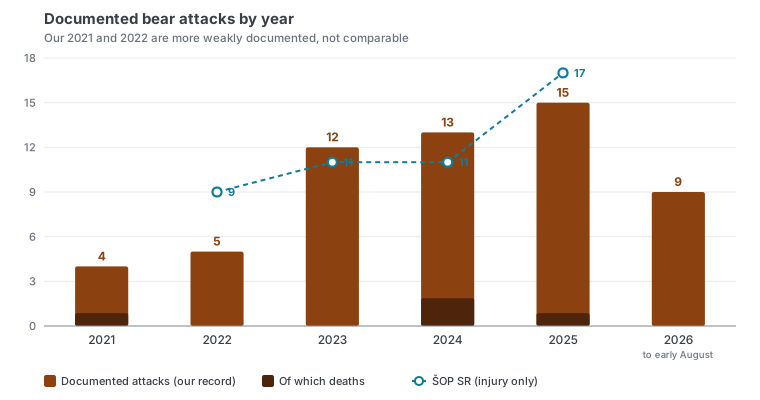
For the long-term trend you therefore have to look elsewhere. An expert review of verified Slovak cases from 1999 to 2023, presented by Robin Rigg, reports an increase from roughly 1.6 attacks per year in 1999 to 2003 to 6.8 attacks per year in 2019 to 2023. That is roughly a fourfold rise over twenty years, and it is our best available estimate of the long-term trend. It is not a peer-reviewed study but an expert review presented at a conference, so that is how we cite it.
The most striking change, though, concerns the worst cases. From 1927 until June 2021, Slovakia did not record a single person directly killed by a bear. Two more confirmed cases followed, in 2024 and 2025. Three fatal attacks in five years, after a pause of nearly a century, is a shift that better news coverage cannot explain.
These are numbers about recorded attacks, not about the number of bears. There are several reasons, and the available data does not let us pin down the cause precisely. It does look as though cases are documented more thoroughly today and as though part of the bear population has learned to use food sources close to human settlements. On top of that, the topic has become a political battleground in Slovakia, and some of the reporting appears to be colored by it.
When and why attacks happen: seven typical situations
This is the part where we go furthest beyond the hard data. What follows are our hypotheses. We base them on the documented circumstances of individual cases, what is known about bear biology, and our own years of moving through this terrain. They are our interpretations, not proven causes. We still felt that if we want to get better at avoiding the next attack, it is worth trying to understand at least part of what is happening. Full proof is impossible because we do not know how many people move through each place, exactly what the bears were doing at the time, and other key details.
At the same time, we think this is the most useful part. If attacks are random, nothing can be done about them. If they have a logic, they can be avoided. And both the data and the biology tell us they have a logic.
We sorted them into seven situations.
1. Winter and early spring: a bear at its den
This is the category we can explain with the most confidence because the mechanism is easy to understand and avoid.
In three cases the vicinity of a den is documented. In February 2026 in Hrboltová, a nursing female attacked a hunter who was walking around a logging site; the den with three cubs was under a rock overhang right next to the attack site, and according to matching statements from both the conservationists and the hunting chamber, his dog provoked the attack. In February 2025 in Partizánska Ľupča, a family of four on a hunters’ path came upon a bear about three meters from its den. In March 2023 near Nedožery-Brezany, a female was denned fifty meters from the plot where forestry workers were planting trees; in the morning they unknowingly disturbed her, and when they were walking down to their cars after work, she attacked one of them.
Why do these encounters end differently from encounters in summer? You have to understand how a bear works in winter.
For the rest of the year, even when a bear is resting or asleep, its body runs at full power. The senses stay on alert and the animal is ready to get up and leave at any moment. Most encounters end with the bear vanishing before you ever notice it.
Winter is different. The metabolism is turned down, the perception of the surroundings is dulled, and the bear reacts more slowly. At the same time, leaving the den carries a much higher cost. It is not a quick escape as it would be in summer. The bear must interrupt its winter rest, find another safe shelter, often far away, and spend energy it cannot replace in winter.
Scandinavian researchers describe the same mechanism: a bear disturbed in its den may attack because its lowered body temperature prevents it from fleeing quickly, rather than primarily to defend the den.
The result is an unlucky combination. A bear in a den registers you late and has no reason to run at the first hint of trouble. It would rather wait for you to move away. But once you walk right up to it, it is too late for a calm exit. A den usually has no back door, so the animal is essentially cornered, and from its point of view only one option remains.
The presence of cubs makes this category even worse. Cubs born in the den over winter can barely move, and a female simply cannot leave quickly with them even if she wanted to.
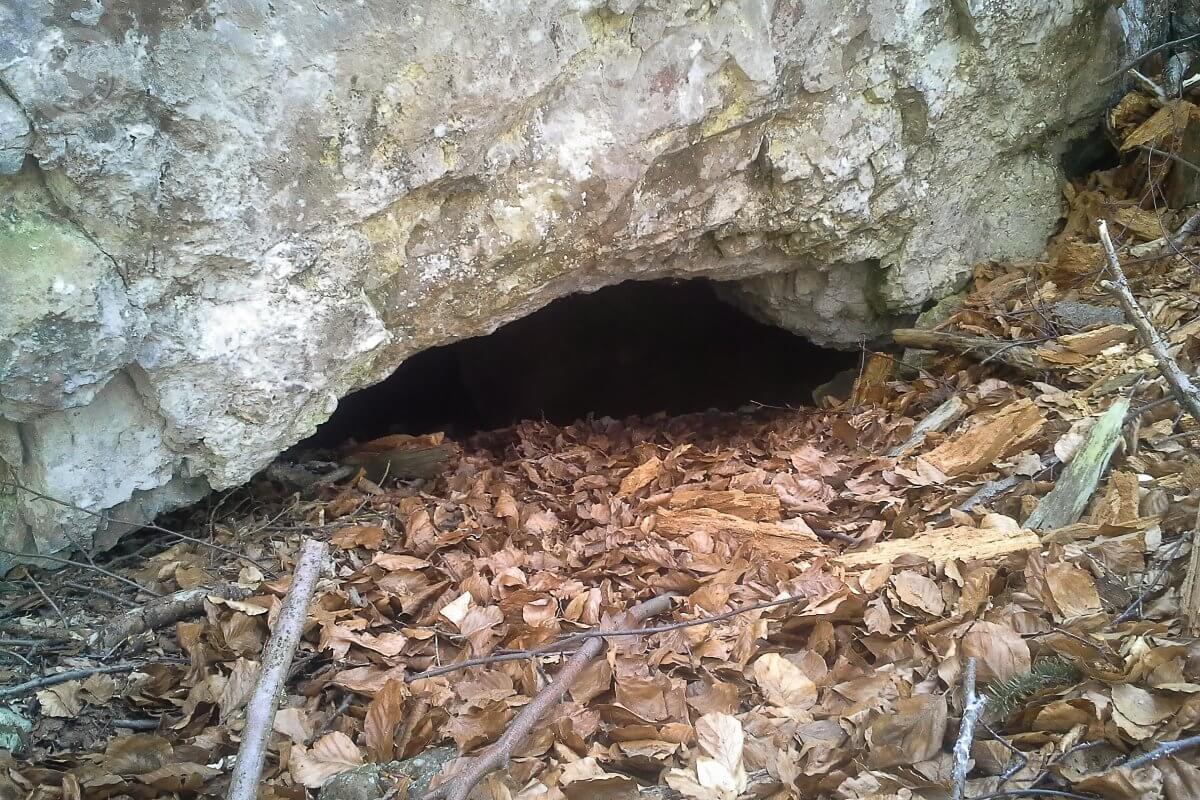
The practical takeaway: in winter and spring, keep away from rock overhangs, uprooted trees, dense young stands and anything that looks like a shelter, and keep your dog on a leash. A dog will find a den before you do, and when it panics, it runs back to you with whatever is chasing it.
2. March: the forest is full of people you never meet there in summer
March leads the whole year with ten attacks. At first glance that is odd, because for hiking, March is one of the weakest months there is.
According to data from the Statistical Office of the Slovak Republic, March accounts for roughly 6 to 7 percent of all overnight stays in the year, while August accounts for about 14 percent. In the Žilina region, which covers the Malá and Veľká Fatra ranges, Liptov and Orava, August is roughly double March. In March, there are far fewer visitors in the mountains than in summer, yet March has more attacks than any other month.
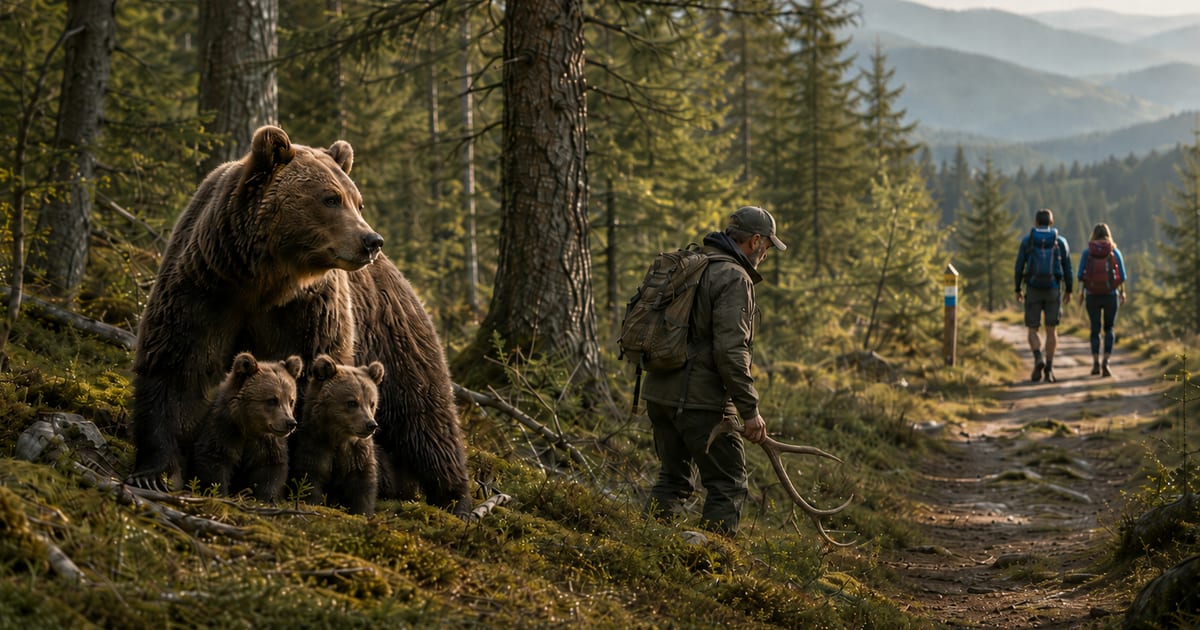
Our hypothesis is that a different kind of person is in the forest in March. Not hikers who chat and stay on the trails, but people who go straight across the terrain: shed antler collectors. Red deer drop their antlers from late February to April, and March is the main month for it. You look for sheds by systematically walking through places nobody visits in summer. It should be added that collecting them without the consent of the local hunting ground user is illegal in Slovakia, and nobody keeps track of how many people actually do it. And of course, if a bear attacks someone during this activity, they will not say they were collecting sheds; in the news they appear as hikers. That makes this hypothesis very hard to confirm from data. Add to that the fact that in March bears are waking up, and females with this year’s cubs are still at their dens or have only just left them.
Two things overlap here: people deep off the paths, and bears in the most vulnerable phase of their year.

One more thing about that statistic: it measures paid overnight stays, in other words holidaymakers. Locals who go out for sheds, mushrooms or firewood in the forest behind the village are not captured at all, even though they are precisely the people who run into bears most often.
3. May and June: mating season and a nervous bear population
The second peak is June, with nine cases. Again, visitor numbers do not explain the peak because July and August are much busier tourist months.
The bear mating season in Slovakia runs from mid-April to early July and peaks in May and June, as stated in the Brown Bear Care Programme for Slovakia. The same window is confirmed by an international study on mating phenology. This is when bears move the most: Slovak telemetry recorded the greatest movement among males in May and June, with one adult male covering 22.2 km in a day. More movement means more opportunities for an encounter.

The second half of the explanation belongs to females with cubs, and it is tied to how slowly bears reproduce. A female leads her cubs for roughly one and a half to two and a half years, and she does not mate for that entire time. So she has a litter only once every two to three years. But if she loses the cubs, she returns to mating quickly. That is why it pays off for an adult male to kill cubs that are not his, and that is why it happens. Conservationists did not invent this idea: the behavior is well-established biology. That still does not mean every male kills every cub he encounters. In Scandinavia, roughly 85 percent of cub deaths fall exactly in the mating season.
A female leading cubs therefore actively avoids males during the mating season, and according to ŠOP SR she “seeks safety in new territories without adult males” (our translation from Slovak). In May and June she is moving through unfamiliar ground, sometimes closer to people, and she is generally stressed. Imagine someone spending weeks actively trying to kill your children in order to start a new family with you; we would all be more on edge than usual.
This is our best explanation of the June peak. It is not the only possible one, and no study directly proves the connection; international reviews attribute summer seasonality more to human activity. But it fits what we see in the data better, especially since the tourist season peaks two months later than the attacks do.
4. October: mushroom season
October is not the peak of the year. With six cases it sits behind March, June and August, level with May. What makes it interesting is something else: it sticks out against its neighbors, because September has three cases and November one. And unlike March and June, the explanation on offer here does not need bear biology at all.
In three of the six October cases, the person attacked was picking mushrooms. Between Malinová and Nitrianske Pravno in 2023, the fatal attack near Hybe in 2024, and Kanianka two weeks after that. The other three cases involved a runner in Valčianska Valley, two hunters near Liptovská Porúbka, and two national park workers in the Veľká Fatra. Again, these were people deep off the trails.
It is worth flipping that around too. In the entire record we have six cases where the victim was picking mushrooms, and half of them fall in October. It is the only month of the year in which mushroom picking is the most common activity of those attacked.
Our hypothesis is that October is the one month when a lot of people head into the forest at once, and they move exactly the way that surprises a bear most. A mushroom picker moves slowly, quietly, head down, and by definition off the trail, through stands and thickets where visibility is worst. It is the same combination we discuss below under close-range surprise, only in October it applies to far more people than during the rest of the year. Add to that the autumn hyperphagia, the period before winter sleep when a bear forages most intensively and covers a lot of ground doing it.
As everywhere in this section, the numbers are small. Three cases are not statistics, and nobody records how many people go mushroom picking in which month, so this cannot be proven. And the Hybe case shows that mushroom picking by itself is not the whole story: six pickers spread out through the forest and each searched alone, so from the bear’s point of view there were six solitary people there, not a group.
5. Runners: a fast approach to a bear that reads it as a threat
We have eight runners in the record, and at first glance they do not fit the pattern. Every other category is built on quiet movement off the trail, while a runner can be heard and usually runs on a road or a trail. Despite that, six of the eight cases ended in hospitalization or worse, including a man from Valčianska Valley who ended up in an induced coma after the attack. They are also spread across the whole year, from January to October, so this is not a seasonal effect.
Our hypothesis has three parts.
First, a runner can be heard, but not as a human. The sound a runner makes is footsteps and breathing. Those are exactly the sounds every larger animal in the forest makes, so for a bear they carry no message saying “a human is coming, better slip away”. The human voice carries that message, which is why we advise calling out, both in the field and in this article, rather than simply making your footsteps louder. On top of that, a regular footfall is easily lost in the noise of a stream, in wind or in dense growth. We have noise masking documented in seven cases overall, though none of the sources mention it explicitly for the runner cases, so we treat this as reasoning, not as a finding. A runner is not quiet the way a stalking hunter is quiet. A runner is quiet just enough to surprise a bear.
Second, a runner takes away the time a bear needs to leave. In the vast majority of encounters, the bear registers you and quietly slips away without your ever knowing it was there. For that it needs two things at once: to detect you at a sufficient distance, and to have enough time to move off. A hiker walks four to five kilometers per hour, a runner two to three times faster. If a bear gets up thirty meters beyond a blind bend, the hiker reaches it in twenty seconds, the runner in ten. That is the whole difference between an animal that manages to withdraw and an animal that suddenly has a human right next to it. The same geometry that works against mushroom pickers works against runners, even though they move through the forest completely differently: noise is not the deciding factor; what matters is how many seconds the bear has left.
Third, fast movement reads differently than slow movement. A defensive attack is a reaction to an approaching threat. A person who moves slowly, talks and changes direction gives the animal a readable signal: I know about you and I am going around you. A runner closes in silently, directly and fast. We are not claiming the bear thinks it is being hunted. We are only claiming that a fast approach leaves the bear few ways to interpret the situation except as a threat, giving it only a defensive response in that moment.
All three factors compound what we already know about females with cubs. In four of the eight cases it was a female leading cubs, and with her, the line beyond which the animal stops retreating and starts defending is even closer.
The practical takeaway: if you run in bear country, treat every blind stretch as if you were about to wake someone up in there. Slow down, call out, make yourself known before you run in. A bell works, and so does your voice. You just have to use it a few seconds earlier than you might expect. Those few seconds are exactly what a runner takes away from the bear.
6. All year round: surprise at very close range
This is the largest category, and it appears year-round. It comes down to simple surprise: a person and a bear end up too close for either to leave safely.
That is why the list contains cases from practically the entire year.

And that is why attacks do not happen where the most people are, but where visibility is worst: in dense growth, in young stands, by a stream that drowns out footsteps, on an overgrown slope.
7. Bears used to people
A separate category is bears that have grown used to finding food near people and have often lost their natural shyness. They behave differently, and their attacks are often harder to prevent because they are hard to predict. We look at this problem further below.
Who gets attacked
In 53 of the 56 cases where we know the victim’s sex, it was a man. The victims’ ages range from 20 to 71, half fall between 35 and 57, and the median is 49.
The activities split into two groups. The first is quiet time outdoors: hiking and walks, mushroom picking, running, walking the dog. The second is work or a pursuit that keeps a person moving off the trails and quietly: forestry work, hunting, checking a trail camera, work in an orchard or at a sheep farm. Eighteen cases in our record belong to the second group, even though these activities account for a far smaller share of the total time people spend in the forest than hiking does.
Put differently, this happens most often to people who know the woods. Not because they are careless, but because they do exactly what surprises a bear most: they move slowly, quietly, off the trail, often into the wind and early in the morning.
Mushroom picking fits that definition to the letter, and we have it six times in the record, three of them in October. That is why it got its own section above.
Running deserves a separate mention. We have eight runners in the record, and this is not a novelty of recent seasons: the first serious case is from October 2022 in Valčianska Valley, where a female attacked a runner three times and he ended up in an induced coma. A runner is not quiet the way a mushroom picker is; but footsteps and breathing sound like an animal, not like a human, and speed does the rest. Why that is a bad combination is covered above in situation five.
One detail is close to home for us. In two cases a person was attacked while checking a trail camera, in Fačkov and near Liptovská Porúbka, where a female bit a hunter as he was swapping a memory card. We hang trail cameras in the places with the most game, and we walk up to them regularly, quietly and often at dusk. It is riskier than most of us like to admit.
The distances where it turns
We think this is the most practical part of the whole article, because many people fear the wrong distance.
A bear that knows about you in time leaves. Scandinavian researchers ran an experiment in which they deliberately approached collared bears on foot and watched what the animals did. The bears got up and left at an average of 69 meters when resting and 115 meters when active. Eighty percent of them moved away during the approach, and not one behaved aggressively. And the key part: the people only noticed the bear in 15 percent of the approaches. The vast majority of encounters play out with the bear knowing about you, quietly leaving, and you never finding out it was there.
The attack comes only once that distance is gone. We could establish the distance in only nine cases, so treat this as indicative. The median is five meters, seven of the nine cases fit within twelve meters, and in one the bear was standing right next to the person. Haring’s analysis of Slovak cases gives an average of twelve meters; we could not verify that number in the original work, but it fits everything else. Practically all of the risk plays out in a band of roughly five to twelve meters, and the whole point is simply never to enter that band.
The reason is the same as at the den. At a hundred meters a bear has options, and it usually picks the quietest one: it leaves in a way you will never know about. At five meters it does not have that option. It has no time to withdraw, it does not know what you will do, and if its cubs are behind it, it does not even want to retreat. A defensive attack is the reaction of an animal that has run out of other options, rather than a deliberate decision to assault a human.
This reverses what many people expect. A bear you can see at a hundred meters is good news. You both know about each other and you both have enough room to withdraw calmly. The dangerous encounter is exactly the other one, at ten meters in a thicket, where neither side has a good option left.
And that is exactly why dense growth is the worst. The same Scandinavian experiment showed that bears in dense vegetation let people approach closer before leaving than bears in open terrain. Where there is no visibility, the animal stays put longer, and the probability that you walk straight into it is higher. That is why making noise makes sense precisely where you cannot see, and not on an open ridge. The goal is simple: make sure the bear knows about you before you enter that five-to-twelve-meter band.
What about groups?
We did not find a single attack on a group of three or more people walking together in the forest. That fits: a group is louder, and a bear knows about it in time.
There are three exceptions, though, and they show the limits of the rule. In March 2024 a bear ran straight through the town of Liptovský Mikuláš and injured five people; that was not a forest encounter but a panicked animal in a built-up area. Then there is the Partizánska Ľupča case we described above: when a group walks right up to a den, its size does not help, because the animal has nowhere to retreat. And finally the most serious exception: in the fatal attack near Hybe in 2024 there were six mushroom pickers, but they had spread out through the forest and each was searching alone. A group only protects you while it stays together and can be heard.
Which bears attack
Where the animal’s sex could be determined, it is almost always a female: 34 cases out of 40.
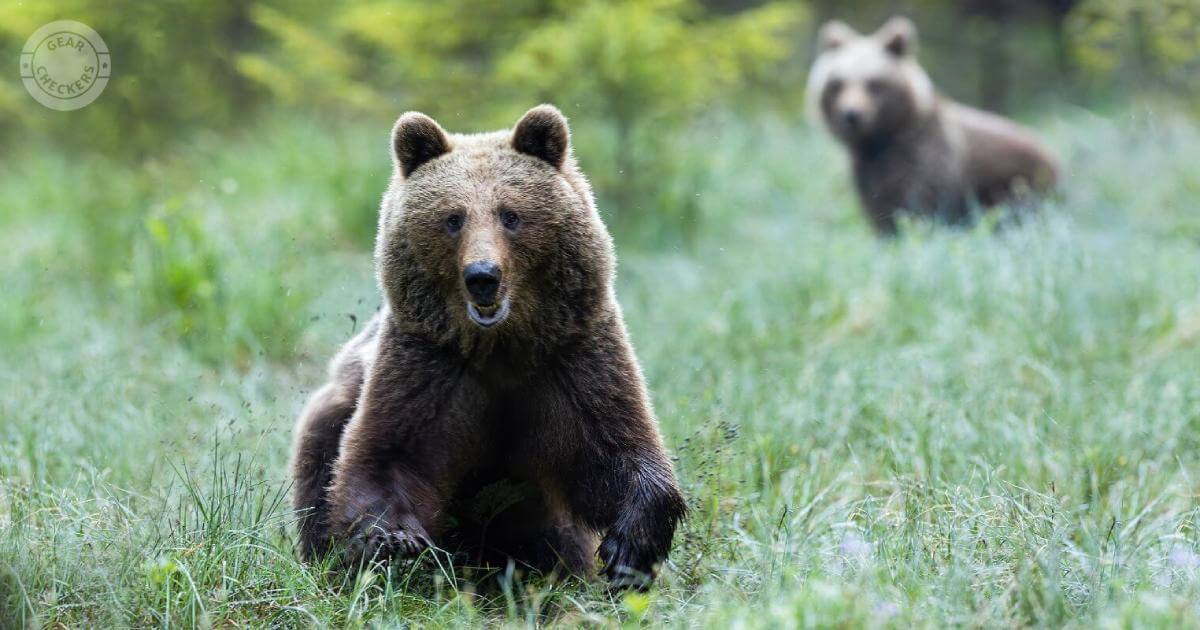
The reason is how a female bear lives. She leads and defends her cubs for a long time, and in that period she is at her most vulnerable. She simply has something to lose, unlike an adult male, who almost always has the option to walk away.
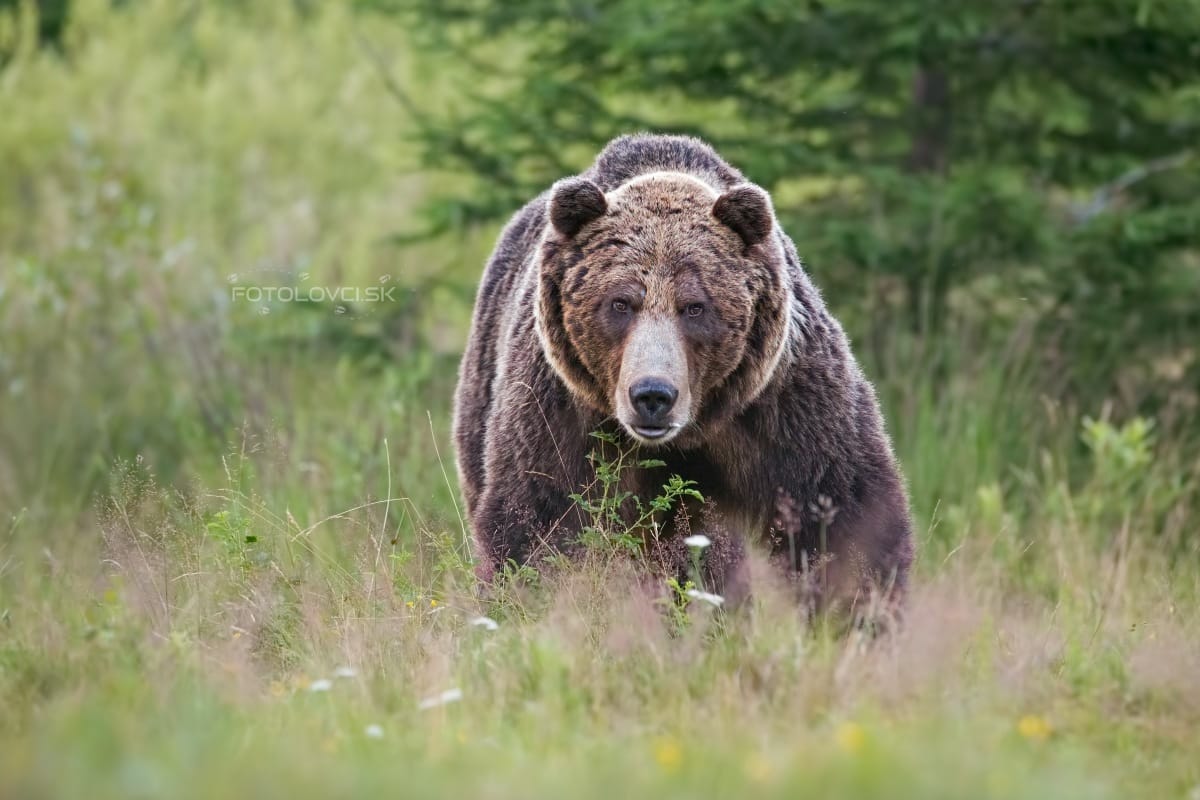
What matters is what follows from this for behavior. A defensive attack unfolds differently from a predatory one. A bear defending cubs or reacting to a scare wants one thing only: for the threat to disappear. That is why these attacks tend to be short, often over within seconds, with the bear running off. In the cases we could analyze in detail, the bear left on its own after the attack forty-one times.
Among the documented Slovak cases there is not a single predatory attack, meaning one where a bear hunted a person with the intent to eat them. That holds for the three direct fatal attacks as well. Even those look like defensive reactions that spun out of control.
Two independent analyses of Slovak cases reached the same conclusion: Haring’s thesis, covering 2000 to 2016, and the newer review by Robin Rigg, covering 1999 to 2023. Neither found a predatory attack, and both report a predominance of females where the sex could be determined.
To be precise: predatory attacks do exist worldwide, they are just rare. In the largest international review of brown bear attacks they make up roughly five percent of the cases where the circumstances could be determined, and all of them occurred in Russia and North America. In Europe excluding Russia, not one was recorded between 2000 and 2015. In Russia, home to roughly half the world’s brown bears, about 18 percent of attacks with a known cause showed predatory features. For a reader in Slovakia the point is that no such case is documented here or in our part of Europe, and that it is extremely unlikely.
One thing to watch out for when reading any overview, ours included: the bear’s identity is only rarely verified. The label “female” appears in news reports more often than the sex of the animal is actually confirmed. That showed in March 2024 in Liptovský Mikuláš, where the bear shot after the attack was assumed to be a male and turned out to be a three-year-old female. Nor can it be ruled out that the intervention team found and shot an entirely different bear than the one that attacked.
Forest versus village: two different problems
From our point of view this is the most useful split the data allows, because each of the two situations calls for something different.
In the forest, attacks stem from surprise and the defense of cubs. They are more common in the morning and in dense growth, and their outcomes are worse. All four deaths belong here.
In a village and on its edge the story is different. Of the ten cases that belong here, nine are from the last three years; the only older exception is a dog walk near the chapel above Poruba in 2022. This is where both of the cases in the entire record involving a bear habituated to human food belong: Jakubovany, where ripe plums had drawn bears for years, and Závažná Poruba, where a bear jumped a man in front of his own house. Injuries tend to be lighter, but the attack happens closer to people.
The main difference is in what can be done about it. In the forest you change your own behavior. In a village you have to change what attracts the bear: fallen fruit, waste, and feeding. A bear that has found a regular food source in a village will keep coming back, no matter how carefully the people there behave.
An expert analysis of Slovak attacks covering the period up to 2023 reported that injuries near villages and towns were rare. So if this is not a coincidence, it is a new phenomenon worth watching.
Some caution is needed when judging the growing number of village cases, though. The numbers are small, and after April 2025, when the government declared a state of emergency, bears were written about far more, so part of the increase may simply be increased attention. We do not use this as proof that there are more bears, or that they have started behaving more dangerously. The data is too weak for that.
What worked in these cases and what did not
Before we get to spray, we need to explain how we built the list because otherwise the numbers can be misleading.
A case enters the list if there was physical contact, or if the person shot the bear at close range. An encounter that ended with properly used spray, the bear running off, and nobody being hurt never appears in any statistics. That is exactly what Lukáš’s case looked like. Our list is therefore biased against spray by its very design: it contains almost exclusively situations in which spray was either absent or did not work. Nobody knows how many times spray has quietly done its job in Slovakia.
With that caveat, we can look at the four cases in the list where spray appears.
It worked once. In March 2025 near Šútovo, a female attacked a man; his son ran over to him, used the spray, and the female left.
Twice it did not work, but in both cases it came out too late. In May 2022 near Hriňová, a female with three cubs attacked from behind; the men only started spraying at the moment she was already tearing at one man’s face, and he ended up in an induced coma. The Lesy SR spokeswoman summed it up at the time by saying that “the defensive effect did not materialize”. In March 2025 near Belá, trail camera footage showed that the man first fended the female off with an axe and only sprayed at the animal as it was retreating; he himself later admitted that in the shock he did not know which side he carried the spray on.
And once the victim had no time to draw it. In Fačkov, a man checking a trail camera had spray on him, but the bear attacked from three meters and he had no chance to reach for it.
Looking at those four cases together, something more important emerges than a simple score. There is not a single case in the Slovak record of spray failing after timely use, meaning before the bear got within reach. The one clean pre-contact use, at Šútovo, worked. The rest are failures of deployment: too late, in shock, blind. That does not change the fact that an attack from behind simply gives you no time to react; but it does change the question worth asking: can you draw the spray before the animal is on you?
Interestingly, the Belá and Šútovo cases happened on the same day, 21 March 2025. These were separate events on opposite sides of the Krivánska Malá Fatra, roughly thirteen kilometers apart as the crow flies, with the main ridge between them.
None of the reports identifies the spray or its age. For Belá, we later checked the weather, and temperatures of 6 to 9 °C rule out a frozen canister as an explanation. What we do know is that worldwide, spray works in the large majority of cases, and that when it does not, one of these things is usually behind it:
- Cold shortens the range. Canister pressure drops with temperature, and the reach differs by tens of percent between summer temperatures and frost. The March and February cases therefore played out in conditions where spray performs worst.
- A canister lasts less time than people think. Most of the pressure is released during the first few seconds of spraying, so emptying the canister does not provide a long defense.
- Not every spray sold in Slovakia is a bear spray. Some products on the market are 150 ml canisters with a low capsaicin content that fail all international minimums for bear spray, including content, range, and spray duration. On top of that, there is no certification for bear sprays in the EU, so a buyer has no way to verify from the label whether a product meets those parameters. In the US such a registration system exists, and a product can be looked up by its number.
- Distance and time decide. The Fačkov case shows that a spray that stays in its holster during an attack from three meters is exactly as useful as one left at home.
We consider bear spray the best portable tool an ordinary person has in this terrain, and we carry it ourselves. At the same time, even in studies with favorable results, some bears continued their aggressive behavior after being sprayed. It is a tool to keep within reach. Use it before the animal is within touching distance, and do not count on it being a shield. And at least once, do a dry run of how it unlocks and which hand you draw it with; Belá is the exact picture of what a first live draw looks like in shock. Our own test also showed that the differences between individual sprays are large, so choosing carefully pays off. We cover the products we tested and how they performed in our bear spray test.
In ten cases the person carried a gun; these were mostly hunters, foresters or national park workers. Four females died in self-defense shootings, and at least three more animals left wounded.
All documented cases since 2021
The table lists all 58 documented cases chronologically. In the Circumstances column we give what the sources can support: time of day, terrain, what could be learned about the bear, and the use of any defensive tools. An empty space means the sources do not mention it, not that it did not happen. The district is in parentheses after the place name.
| Date | Place (district) | Who and what they were doing | Circumstances | Outcome | Source |
|---|---|---|---|---|---|
| 19 May 2021 | Šútovo (trail to the waterfall) (Martin) | man, repairing a footbridge railing | afternoon ~16:00, by a stream, marked trail, female, defending cubs | hospitalized | SME, STVR |
| 13 Jun 2021 | Liptovská Lúžna (Banskô) (Ružomberok) | man 57, regular walk | afternoon, by a loud stream, close-range surprise | death | Lesy SR, Pravda |
| 22 Aug 2021 | Dúbravy (Hradné lúky) (Detva) | local man, walk (also mushrooms), group of 2 | morning, meadows above the village, female, close-range surprise (attack from behind) | minor injuries | TU Zvolen |
| 1 Sep 2021 | Hradište (Poltár) | woman 58, picking blackberries in an orchard, group of 2 | early evening, overgrown orchard, female with 2 cubs, defending cubs | hospitalized | Pravda, ŠOP SR |
| 9 May 2022 | Očová (Jasle near Kyslinky, Poľana) (Zvolen) | forester 33, inspecting a reforested plot | morning, young dense growth, female with 3 cubs, defending cubs | minor injuries | Bystricoviny, TASR |
| 11 May 2022 | Hriňová (Drábovka, near Hotel Poľana) (Detva) | two nature photographers, group of 2 | evening, low-visibility terrain, marked trail, female with 3 cubs, defending cubs, spray only used during contact | critical condition (2 people) | Bystricoviny, SME |
| 10 Jun 2022 | Horná Ves (Barborská cesta, Kremnica Hills) (Žiar nad Hronom) | man 58, walking through the forest to work | evening, marked trail, female with a cub, defending cubs | hospitalized | ŠOP SR, TASR |
| 13 Jun 2022 | Poruba (chapel above the village) (Prievidza) | elderly man, walking a dog | morning, thicket by the calvary, close-range surprise, dog present | minor injuries | ŠOP SR, TASR |
| 12 Oct 2022 | Valčianska Valley (Lúčanská Malá Fatra) (Martin) | runner 38 | afternoon, young beech forest, marked trail, female with cubs, defending cubs | critical condition | Pravda, HZS |
| 24 Jan 2023 | Kanianka (Kanianske Lazy) (Prievidza) | runner 29 | afternoon, forest road, young bear ~80 kg, close-range surprise | minor injuries | TASR |
| 12 Mar 2023 | Sučianska Valley (near Malý Kriváň) (Martin) | man, hiking/walk | dense growth, close-range surprise | hospitalized | Žilinak, Interez |
| 22 Mar 2023 | Tužina (Rysia Valley) (Prievidza) | man 38, running, group of 2 | afternoon, young beech growth, probably a male, close-range surprise | minor injuries | ŠOP SR, TASR |
| 30 Mar 2023 | Nedožery-Brezany (Ostrá Valley) (Prievidza) | forestry worker 55, tree planting, group | midday, near a den (50 m), female with cubs, defending the den, dog present | minor injuries | Pravda, Noviny |
| 1 May 2023 | Višňové (Žilina) | forester and hunter, tracking a wounded wild boar, group of 2 | morning, thicket, close-range surprise, gun used | hospitalized (2 people) | Pravda, Žilinak |
| 22 Jun 2023 | Dolná Bzová forest district (Ostrôžky) (Lučenec) | logger | morning, female | hospitalized | SME, TV Noviny |
| 7 Jul 2023 | Háj (Veles farm) (Turčianske Teplice) | man 20, farm work, group of 2 | morning, farm; his mother drove the bear off with a pitchfork, identity confirmed after a car collision | hospitalized | TASR, TA3 |
| 15 Jul 2023 | Liptovský Hrádok (Hradská hora) (Liptovský Mikuláš) | runner 58 | early morning, surprised while running | hospitalized | Žilinak |
| 23 Aug 2023 | between Liptovská Kokava and Pribylina (Liptovský Mikuláš) | mushroom picker 57 | afternoon, tall grass by a loud river, female with 2 cubs, close-range surprise | minor injuries | Pravda |
| 24 Oct 2023 | between Malinová and Nitrianske Pravno (Prievidza) | man 49, picking mushrooms | morning, overgrown abandoned orchard, close-range surprise (the attack lasted seconds) | minor injuries | ŠOP SR, TASR |
| 25 Nov 2023 | Kľačno (ridge towards Vrícko) (Prievidza) | hunter, driven hunt | female ~150 kg with 3 cubs, defending cubs, he shot her from ~80 cm after she knocked him down; she fled wounded | no injury | ŠOP SR, Noviny |
| 27 Dec 2023 | Sklabinský Podzámok (Veľká Fatra) (Martin) | married couple on a hike, group of 2 | afternoon, ridge trail, close-range surprise | hospitalized | Les & Letokruhy, Žilinak |
| 15 Mar 2024 | Demänovská Valley / Low Tatras (below Na Jame) (Liptovský Mikuláš) | woman 31, hiking/walk, group of 2 | afternoon, dense growth, close-range surprise | death | Denník N, CBS |
| 17 Mar 2024 | Liptovský Mikuláš (town) (Liptovský Mikuláš) | several people, including a 10-year-old girl, near houses in town | midday, in town | minor injuries (5 people); the bear was removed by the intervention team | Pravda, TV Noviny |
| 30 Mar 2024 | Stráňavy (Múzeum area) (Žilina) | young man, picking mushrooms | morning, dense growth, close-range surprise, gun used | no injury; bear shot and wounded in self-defense | ŠOP SR, ŠOP SR |
| 31 Mar 2024 | Pribylina (Tatra highway trail) (Liptovský Mikuláš) | married couple on a walk, group of 2 | afternoon, ~7 km from the village, marked trail, close-range surprise, dog present | minor injuries | ŠOP SR, TV Noviny |
| 4 Apr 2024 | Kvačany (near Liptovská Sielnica) (Liptovský Mikuláš) | man 35, forest work | morning, dense growth, close-range surprise, gun used | hospitalized | ŠOP SR |
| 14 Apr 2024 | Želobudzská skala (Poľana) (Detva) | two hikers, hiking/walk, group of 2 | afternoon, more open forest, close-range surprise | hospitalized (2 people) | Denník N |
| 21 Apr 2024 | Povina (Kysucké Nové Mesto) | man 34, hiking/walk | afternoon, marked trail, female, defending cubs | minor injuries | STVR |
| 1 May 2024 | Selce (near Banská Bystrica) (Banská Bystrica) | mushroom picker 57 | afternoon, more open forest, female with 2 cubs, defending cubs | minor injuries | Interez |
| 17 Jun 2024 | Trnavá Hora (Ladno) (Žiar nad Hronom) | man 71, mowing near the village | afternoon, village edge, female, defending cubs | minor injuries | TASR |
| 24 Jul 2024 | Šútovo (Martin) | man 34, cycling | evening, more open forest, female, defending cubs | hospitalized | Pravda, Les & Letokruhy |
| 7 Aug 2024 | Bobrovecká Valley (Western Tatras, near Oravice) (Tvrdošín) | man, hiking/walk | morning, marked trail, female, defending cubs | minor injuries | Žilinak, Pravda |
| 5 Oct 2024 | forest near Hybe (Liptovský Mikuláš) | mushroom picker 63, group of 6 (each searching alone) | morning, dense growth, bait site ~700 m away, close-range surprise | death | STVR, SITA |
| 19 Oct 2024 | Kanianka (Prievidza) | man 67, picking mushrooms | morning, meadow/clearing, female, defending cubs | hospitalized | TV Noviny, TA3 |
| 7 Jan 2025 | Očová (Poľana) (Zvolen) | man, forest work | morning, female, gun used | minor injuries | TASR, SME |
| 1 Feb 2025 | Fačkov (Žilina) | man 38, checking a trail camera | afternoon, dense growth, close-range surprise, no time to use his spray | hospitalized | STVR, TV Noviny |
| 15 Feb 2025 | Partizánska Ľupča (Liptovský Mikuláš) | family of four on a walk, group of 4 | afternoon, at a den (3 m off the path), defending the den | minor injuries | TASR |
| 21 Mar 2025 | Šútovo (near the waterfall) (Martin) | man 51, hunting, group of 2 | evening, female, spray worked | hospitalized | TV Noviny |
| 21 Mar 2025 | Belá (Žilina) | local man, walking a dog | evening, female with 4 cubs, defending cubs, dog off leash, spray used late, drove her off with an axe | no injury | TV Noviny |
| 30 Mar 2025 | Detva (Zapriechody / Kochlačka, near Kriváň) (Detva) | man 59, hiking/walk | dense growth, corn bait site ~400 m away | death | Pravda, SME |
| 18 Apr 2025 | Králiky (ski resort) (Banská Bystrica) | man 50, walking a dog | evening, in rain, near the ski resort, dog present | hospitalized | ŠOP SR, Pravda |
| 24 May 2025 | Sučany (Martin) | man 49, shortcut through a thicket | afternoon, village edge, female with 4 cubs, defending cubs | hospitalized; the intervention team shot the female 17 days later | SME, source |
| 24 Jul 2025 | Oravská Jasenica (by the cabins) (Námestovo) | man, at a holiday cabin | midday, village edge | minor injuries | TA3, Žilinak |
| 14 Aug 2025 | Hybe (Liptovský Mikuláš) | man 28, walking a dog | evening, village edge, female, dog present | minor injuries | Noviny, SME |
| 20 Aug 2025 | Liptovský Ján (Liptovský Mikuláš) | runner | morning, female, defending cubs | hospitalized | SITA, TA3 |
| 4 Sep 2025 | Nedožery-Brezany (Prievidza) | runner 27, near a hunting cabin | evening, female, defending cubs, bait sites in the area | hospitalized | Trenčínak |
| 26 Sep 2025 | Jakubovany (built-up area, by the cemetery) (Liptovský Mikuláš) | man 46, at his house in the village | at night, in the village, female with 2 cubs, bear habituated to food in the village | hospitalized | SME |
| 10 Oct 2025 | Liptovská Porúbka (Liptovský Mikuláš) | two hunters, hunting, group of 2 | evening, meadow/clearing, female, gun used | hospitalized (2 people); bear shot dead in self-defense | Noviny, Žilinak |
| 29 Oct 2025 | Liptovské Revúce (below Repište, Veľká Fatra) (Ružomberok) | two national park workers, forest work, group of 2 | afternoon, dense growth, female ~130 kg, gun used | no injury; bear shot dead in self-defense | source, SME |
| 15 Feb 2026 | Hrboltová (part of Ružomberok) (Ružomberok) | man 57, forest work, group of 2 | meadow/clearing, nursing female, defending cubs, dog present, gun used | hospitalized; bear shot dead in self-defense | Veľká Fatra NP, Pravda |
| 16 Apr 2026 | Banská Bystrica (Urpín hill, by the observatory) (Banská Bystrica) | man 31, running | morning, more open forest, female | hospitalized | TASR, Denník N |
| 2 Jun 2026 | Stráňavy (below Havrania skala) (Žilina) | runner 36 | evening, meadow/clearing, marked trail, female, defending cubs | hospitalized | Info.sk, Interez |
| 4 Jun 2026 | Liptovská Anna (Sestrč area) (Liptovský Mikuláš) | forestry worker 37, forest work | morning, dense growth, probably a young male, close-range surprise | minor injuries | STVR |
| 21 Jun 2026 | Grobňa (Kremnica cadastre, ~3 km from Krahule) (Žiar nad Hronom) | hunter | morning, more open forest, marked trail, female ~7 years old with a cub, defending cubs, gun used | no injury; bear shot dead in self-defense | Pravda, TA3 |
| 23 Jun 2026 | Liptovská Porúbka (Liptovský Mikuláš) | hunter ~41, checking a trail camera | evening, dense growth, female, gun used | hospitalized; the bear was removed by the intervention team | Pravda, TA3 |
| ~11 Jul 2026 | Závažná Poruba (at a house, ~100 m from the municipal office) (Liptovský Mikuláš) | man, at his house in the village | evening, in the village, bear habituated to food in the village | minor injuries | ŠOP SR, TASR |
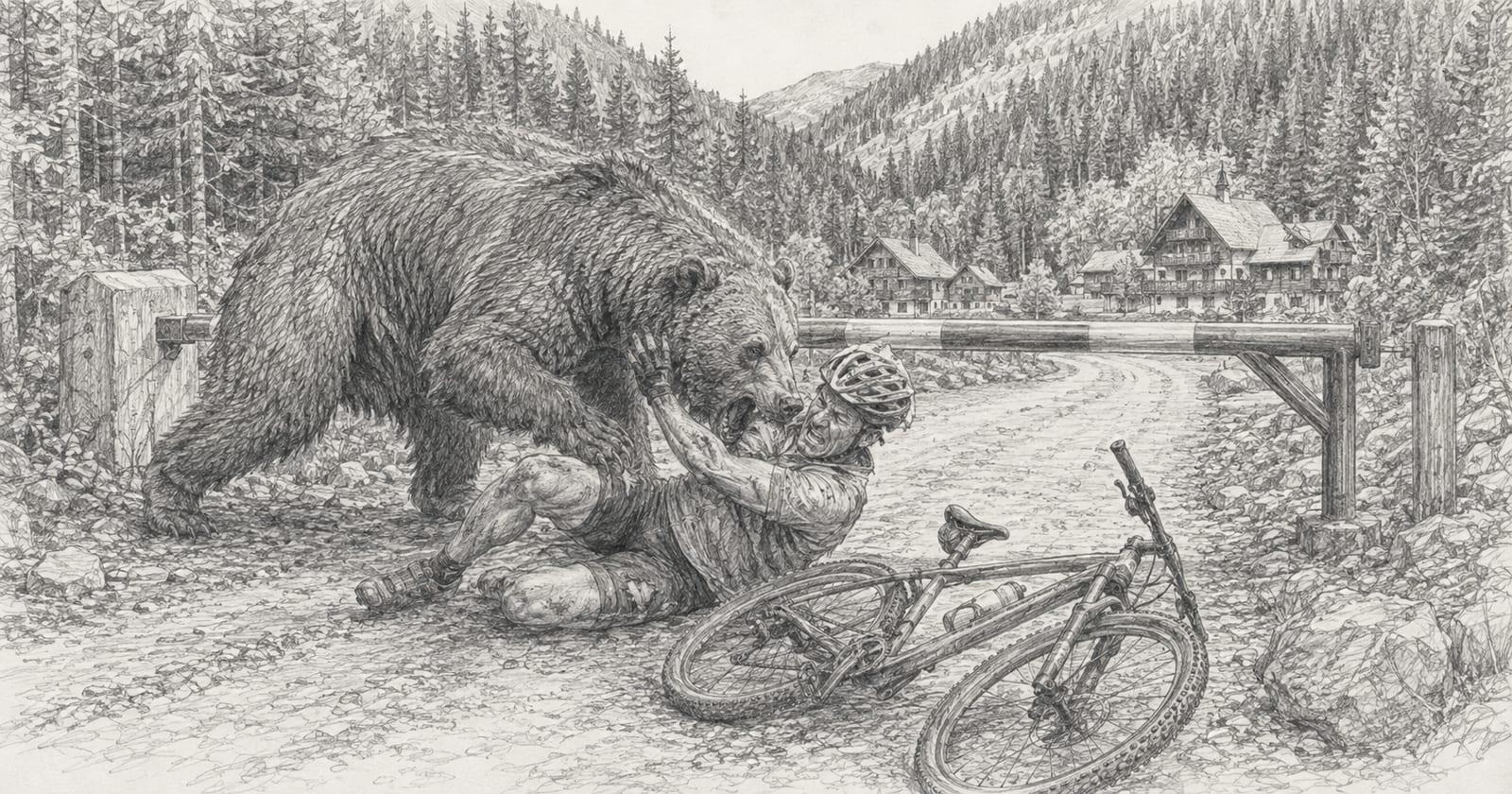
| 8 Aug 2026 | Valčianska Valley (valley entrance by Snowland) (Martin) | cyclist 55 | evening ~19:00, forest road by the barrier, bear not identified | hospitalized | more details |
| 9 Aug 2026 | Turany (Turany-Trusalová feeder road) (Martin) | man 42 | early evening, attack site not published, female ~18 years (136 kg) with two cubs | hospitalized; the intervention team eliminated the female and both cubs | more details |
The data we worked from
This part is for readers who want to know how we arrived at the numbers. You will not miss anything by skipping it.
We count a case as an attack if at least one of three things happened: a bear made physical contact with a human, regardless of whether the person was injured; a point-blank shot stopped a bear in a self-defense situation that would most likely have ended in contact; or a person died as a result of a bear’s behavior, even without contact. We have 58 such cases, and it is the single number every chart and every analysis in this article stands on. The Turany case of 9 August 2026 was initially listed as unconfirmed, because the police spoke only of a possible attack; we counted it a day after the attack, when the intervention team eliminated the female it designated as the attacker and official statements confirmed the attack.
What matters is what the definition leaves out: the severity of the injury. A person a bear knocked to the ground and left alone simply got lucky. It is not a different kind of event from the one that ended in lacerations, and if we counted it differently, we would be saying that an attack only counts when the victim is unlucky. That is why the five cases in which a bear charged or attacked and the person managed to shoot it or drive it off are counted like all the others.
For the same reason we also count the fall in Demänovská Valley in March 2024, where a woman died falling into a ravine while fleeing from a bear. There was no contact, but without that bear she would not have fallen. Nobody jumps off a cliff for fun.
We left out one borderline case: a female charging a hunting officer in a fenced game preserve near Kováčová in April 2023. Nobody was hurt, but that is not why we excluded it: a preserve with bait sites is not open country. The setting drove the exclusion, not the outcome. It is also the only case that fails the close-range-shot criterion as well: the female veered off about five meters before the man and was not hit.
One consequence of this definition needs saying out loud. The official ŠOP SR statistics count only attacks with injury, so our number is by definition higher than theirs. It is not a dispute about facts, only about what gets counted.
Encounters that end well never make it in. If someone turns a bear away with spray, or manages to back off calmly, it is recorded nowhere. It is the biggest hole in bear data we know of, and we come back to it in the section on defensive tools.
We limited our sources to major news outlets and official institutions, meaning ŠOP SR and its intervention teams, national park administrations, the state forest company Lesy SR, the Mountain Rescue Service, and forensic studies where available. The reason is simple: a large share of what gets published about bears spreads panic rather than information. So we only worked with cases where we found enough information from a serious source. For every case, the table links to the original report or the official statement. Where we processed a separate page for a case, the link goes there, and the full dated source list is on that page.
We always tried to establish the day of the attack, not the day the report was published. Some public lists record the article date, so for more than fifteen cases we shifted the date, usually back by a day or two. While working on this article we also corrected the severity for two incidents, because it turned out nobody had been injured in them; under the definition above, that has no bearing on whether they count as attacks.
For 2021 and 2022 we hit the limits of public sources. ŠOP SR reports nine attacks for 2022; even after a deep search we could reliably document five. The lower numbers for the first two years therefore do not mean there were fewer attacks then. They mean less was written about them.
Even the official counts differ by institution. For 2024, ŠOP SR reports eleven attacks and the environment ministry fifteen. There is no unified official register anyone could look into.
And one more thing that caused a lot of confusion around this topic. In 2025, a figure went around both the world’s and the domestic media claiming there had been about 1,900 bear attacks in Slovakia. It was picked up by the Associated Press, among others. In reality it was the number of reports of bear presence near villages, as published by the environment ministry, that is, sightings, not attacks. The same ministry recorded fifteen attacks. A report and an attack are two completely different things here.
Finally, one thing our numbers cannot tell you. We cannot compute the risk per hour spent outdoors, because nobody measures how many people move through bear country and for how long. Every number in this article speaks about counts of events, not about the probability that it happens to you.
What we do not know
This article stands on public sources, so it has clear limits.
After a deep search of every case, the time of day is unknown in only three incidents. A dog figures in seven cases, and in at least two of them, Belá and Hrboltová, it apparently triggered the attack. Since older reports often did not mention a dog at all, its real role is likely bigger.
We do not attribute repeated attacks in the same village to the same animal, even though Šútovo (May 2021, July 2024, March 2025), Kanianka (January 2023, October 2024), Očová (May 2022, January 2025), Nedožery-Brezany (March 2023, September 2025) and Liptovská Porúbka (October 2025, June 2026) all appear in the list more than once. No official source draws that connection, and in Šútovo the three cases happened at three different places in the valley over a span of four years. A more likely explanation is that people and bears have long crossed paths in these locations because they are narrow valleys with busy trails through good habitat, or because another long-term local problem exists there.
And one more example of how little we sometimes learn. After the attack on a logger at Dolná Bzová in 2023, ŠOP SR was supposed to establish during its site inspection whether the female had cubs. We found no published result. The widely repeated claim from that case, that not even the noise of machinery scared the female off, comes from a Lesy SR press release issued as part of a call for regulation rather than from an independent expert assessment.
What to take away
We ordered the recommendations by how strongly our data supports them.
- Make yourself known where visibility is poor. In dense growth, by a loud stream, at dusk and against the wind. On an open ridge it serves no purpose.
- In winter and spring, think about dens. Keep away from rock overhangs, uprooted trees and dense young stands. A bear in a den registers you late and has nowhere to retreat.
- Keep the dog on a leash. In the best-documented cases where a trigger can be identified, it was a free-running dog. In late winter and spring this goes double.
- Do not go into dense growth alone, and keep the group actually together. Near Hybe, six mushroom pickers spread out through the forest and each searched alone. A group protects you through its combined noise and presence. Simply having several people on the same trip does not help if they split up. At a den, even that does not help. In mushroom season this goes double: half of the October cases in our record are mushroom pickers.
- If you carry spray, carry it so you can draw it in a second, and use it before the bear reaches you. In winter, expect a shorter range.
- If you run in bear country, assume the bear has no time to give way. It hears you, but footsteps and breathing sound like an animal; only the human voice warns it. And you close the distance two to three times faster than a walker. Our record holds eight attacked runners, six of whom ended up in hospital. Slow down before every blind stretch and call out; a bell helps too.
- Do not run. The only death of a woman in the entire record was caused by a fall during flight, not by the bear itself.
- In a village, remove the food that attracts bears. Fallen fruit, compost and waste are the reason a bear comes into a village. Without them it has nothing to look for there.
- Report a bear that shows no fear. An animal that does not flee, comes to houses for food or repeatedly shows itself near people is a different case from a bear that flashed across your path. It is the first kind that is worth reporting.
In our own practice, points one and five concern us the most. We check trail cameras regularly at the same spots where game is thickest, and we do it quietly. Two cases on this list are about exactly that.
Frequently asked questions
Are bear attacks increasing? Over the long term, yes: from roughly 1.6 attacks per year at the start of the millennium to just under seven in recent years. We break it down above in the trend section, including why this is not automatically a statement about the number of bears.
How many bear attacks happen in Slovakia per year? According to ŠOP SR it has been roughly ten to seventeen attacks with injury per year in recent years. Those figures count only attacks with injury. In our list, which counts attacks under the definition above, 2023 comes to twelve, 2024 to thirteen, 2025 to fifteen, and for 2026 we have nine up to early August. The years 2021 and 2022 are more weakly documented, so their lower numbers are not comparable.
When did a bear last attack a person in Slovakia? The most recent documented case in our record is from 9 August 2026, when a female bear attacked a 42-year-old man near the Turany feeder road in the Turiec basin; he was hospitalized, and the intervention team eliminated the female and her two cubs. We covered the case in a separate report. We update the table above with every new documented case.
How many people have bears killed in Slovakia? Four people have died since 2021. Three cases are direct fatal attacks: Liptovská Lúžna 2021, Hybe 2024 and Detva 2025. In the fourth, in March 2024 in Demänovská Valley, a woman died falling into a ravine while fleeing from a bear. Official statistics do not count her among the attack victims; we count her among the deaths caused by a bear.
Do bears attack people as prey? Among the documented Slovak cases there is not a single such attack. All of them are defensive, a reaction to close-range surprise or the defense of cubs.
When is the risk highest? The year has two peaks, March and June, and attacks happen overwhelmingly in daylight. It does not track when the mountains hold the most tourists, but what bears are doing in a given period and which people are moving off the trails at the time. Right behind the two peaks comes October, in which, according to our record, it is mostly mushroom pickers who get attacked.
Should I be afraid of a bear I can see a hundred meters away? No. That is exactly the situation you want: you know about each other, and you both have room to leave calmly. The risky encounters are the ones at ten meters in a thicket, where there is no time to prepare anything.
Does bear spray help? In the documented Slovak cases it clearly helped once; in the two cases cited as failures, the spraying only began during a contact attack, and once the victim had no time to draw it. There is no case in the record of spray failing after timely use before contact. It has to be added that encounters where spray worked and nobody got hurt are never recorded anywhere, so the list is biased in this respect. We consider it the best portable tool there is, but it only works if you have it within reach and use it in time.
What should I do if I meet a female bear with cubs? Do not run, do not approach, let her know about you in a calm voice, and back away slowly in a way that leaves her a clear path out.